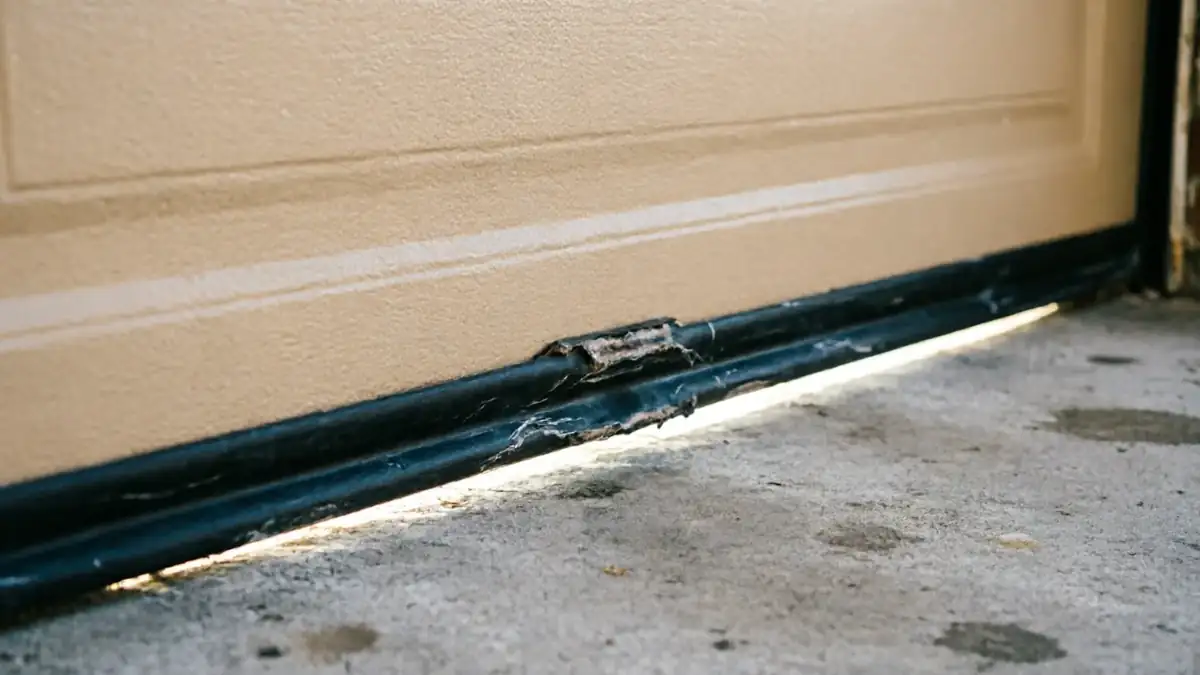
Johnstown sits in a severe cold climate band, and that matters more for a garage door than most people think. Cold doesn't just stiffen the rubber at the bottom of the door - it shrinks it, and on a door that's been in place since the house was built, that shrinkage opens gaps you can feel standing six feet back from the door on a January morning. With housing in this service area built mostly between 1938 and 1980 (median year 1952), a lot of these doors still have their original bottom seal track, or a replacement seal jammed into hardware that was never sized for today's vinyl astragal. The result is draughts along the bottom edge and sometimes down the sides where the old wood jambs have warped half an inch out of square over seventy years. None of that is a design flaw - it's just what cold does to a seal that's outlived its rubber. The fix usually isn't the door itself. It's the track the seal sits in, and whether that track still holds a bead tight enough to compress when the door comes down.
The Problem
Across the 34 named areas we work in, most of the housing stock predates 1960, which means a lot of garage doors were framed to a jamb that's settled, shifted, or been reframed once already with lumber that doesn't match the original dimensions. A new weather seal bought off a shelf assumes a straight jamb and a flat floor. On a lot of these older Johnstown-area houses, neither is true anymore. So the seal looks installed correctly and still leaks air at one corner, because the door isn't meeting the slab square anymore - it's meeting it at a slight twist that's been there since the concrete settled sometime in the 1960s or 70s. That's the actual problem more often than a bad seal: not a part that failed, but a frame that moved under a part that can't flex to match it. Chasing the draught with seal after seal doesn't fix that. It just hides the wrong part of the leak for a season.
What You Pay
We don't have a flat number to quote you here without seeing the door - too much depends on whether the jamb needs shimming, whether the bottom panel has rusted at the seal retainer, or whether it's a straightforward seal swap. What we can tell you is what drives the cost up: an out-of-square jamb takes longer to seal correctly than a square one, and if the bottom panel itself has corroded where the old seal sat, that's a panel repair job on top of a seal job, not instead of it. Ask for the breakdown before work starts so you know which part of the bill is labor for squaring things up and which part is materials.
What to Look At First
Before you call anyone, do this: close the door at night and run a hand along the bottom edge and both side jambs. Cold air moving against your palm tells you more than daylight ever will, since gaps that look fine in the sun show up the moment the temperature drops, which in this area it does hard and for months at a time. Check the corners first - that's where an out-of-square jamb on an older house shows up, not the middle of the door. If the seal itself is cracked, flattened, or pulling out of its track, that's a cheap fix. If the air is coming from where the door meets the frame rather than through the seal material, that's the jamb, and that's worth mentioning when you call, because it changes what the job actually involves.
Rubber seals shrink in cold weather, and Johnstown's climate band is classified severe cold, so that shrinkage is more pronounced here than in a milder region. A seal that seats fine in July can pull away from the floor by January. If the draught disappears again in spring, the seal material itself is usually the cause, not the frame.
Is it the seal or the frame that's letting cold air in?
Run your hand along the door at night. A draught right along the bottom edge is usually the seal. A draught at a corner or along one side jamb more often means the frame has shifted, which is common in houses built before 1960 in this area, where settling over decades has put a slight twist in the original jamb.
Can I just replace the seal myself?
On a square jamb and a straight bottom panel, yes, it's a reasonable DIY job. The trouble comes when the jamb isn't square anymore, which is common in housing from the 1938-1980 era here - a standard seal won't compress evenly against an uneven frame no matter how well it's installed.
Ready to get your garage door sorted?
Tell us what it’s doing and where you are in Johnstown - we’ll take it from there.